




Impact
15 Rock wanted to scale decarbonization consulting without scaling headcount. This prototype compresses the slowest part of the workflow: turning scattered public and client data into a structured emissions and asset view, then producing a clear, defensible decarbonization plan with dashboards and a client-ready report.
Client overview
15 Rock is a sustainability consulting firm helping companies reduce carbon emissions while maintaining profitability. Their work requires analyzing operations, assets, and emissions drivers, then translating that into practical roadmaps.
The problem
15 Rock faced three bottlenecks:
- Manual research: Collecting and summarizing company operations, assets, and emissions information across reports and sources was time-consuming.
- Complex analysis: Effective strategies require linking emissions drivers to operational realities and financial constraints, not generic recommendations.
- Limited scalability: Manual processes constrained the number of clients the team could support.
Goals
- Build an AI prototype to automate research and accelerate analysis.
- Support emissions and asset modeling to identify decarbonization opportunities.
- Provide clear visualizations and a structured, client-ready report.
- Keep the system modular for future expansion.
The solution
Krazimo built a prototype AI platform that streamlines 15 Rock’s consulting workflow:
- Automated research: Collects and organizes information from public reports and documents.
- Structured extraction: Converts unstructured disclosures into a usable fact base (assets, emissions signals, operational drivers).
- Strategy generation: Identifies high-impact decarbonization levers tied to the company’s footprint.
- Dashboards: Visualizes hotspots, assets, and recommended initiatives.
- Report generation: Produces a structured plan that consultants can review and deliver.
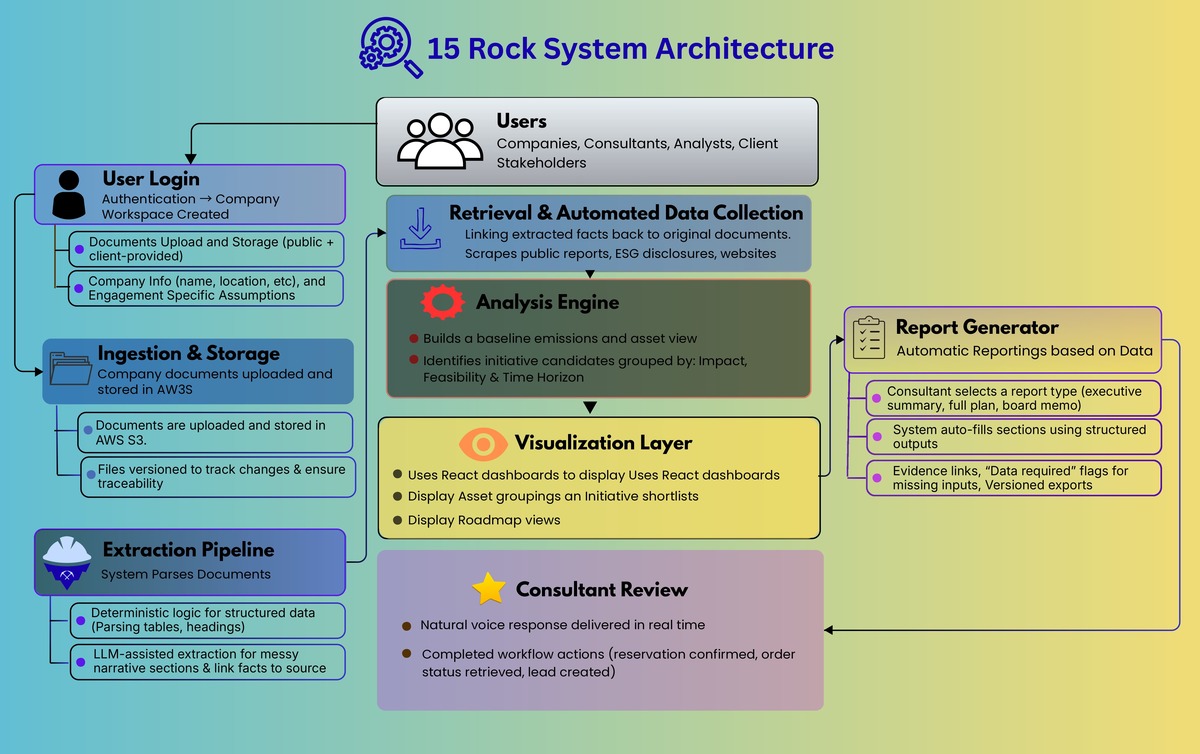
Architecture overview
The prototype follows a “workspace-driven” architecture:
- Company workspace: A single place to store documents, extracted facts, assumptions, analysis runs, and outputs.
- Ingestion and storage: Public and client-provided documents are stored in S3 with versioned artifacts.
- Extraction pipeline: Combines deterministic parsing (tables, headings) with LLM-assisted extraction for messy narrative sections, producing structured outputs.
- Retrieval layer: A document retrieval component grounds recommendations and enables traceability back to sources.
- Analysis engine: Builds baseline emissions and asset views, then proposes initiative candidates grouped by impact, feasibility, and time horizon.
- Visualization layer: React dashboards for exploring hotspots, asset groupings, initiative shortlists, and roadmap views.
- Report generator: Creates a template-based deliverable populated from structured outputs, includes evidence links, flags data gaps, and supports versioning.
How report generation works
- Consultant selects a report template (executive summary, full plan, board memo).
- The system auto-fills sections from the latest baseline, hotspots, and initiative shortlist.
- Major claims attach references to source material; missing inputs become explicit “data required” callouts.
- Consultant reviews, edits, and approves.
- The platform exports and versions the final report with input provenance.
Implementation snapshot
- Backend: Python (FastAPI), serverless execution via AWS Lambda
- Storage: AWS S3 for documents and generated artifacts
- Frontend: React dashboards
- Data collection: Web scraping from public sources
- Delivery: Prototype completed in ~4 months, designed for iterative expansion