


Client Overview
Dr. Jason Emer runs a busy, high-end aesthetic medicine practice in Beverly Hills. Patients reach the clinic every way imaginable — the website, phone calls, texts, email, in-person visits, and a very active Instagram. The goal was to grow without losing the premium, personal experience that keeps patients coming back.
The Problem
Fast growth created friction the team felt every day:
- Conversations were scattered across Salesforce, phones, email, and Instagram, with no single place to see them.
- Context was hard to find — past calls, old quotes, appointment history, notes, consent status.
- Leads slipped through the cracks, especially when no one replied in time.
- Calls were recorded but not useful without someone listening back and writing them up.
- Instagram was overwhelming — patient messages often went answered late, or not at all.
- The clinical and business systems didn’t talk, so staff couldn’t act quickly or consistently.
Goals
- Give staff one place to run everything: leads, accounts, messages, scheduling, notes, consents, and reporting.
- Make every conversation searchable — calls, texts, email, and social.
- Stop losing leads with simple rules and alerts.
- Automate the front door of patient discovery — especially Instagram — while staying on-brand.
- Fit around the tools they already use, instead of ripping everything out.
The Solution
We built two systems that work as one:
- A unified practice platform — one place for staff to run the business, plus a guided patient intake.
- An AI concierge for Instagram and live chat.
Together, they turn scattered interest into organized intake, timely follow-ups, and a clear view of what’s working.
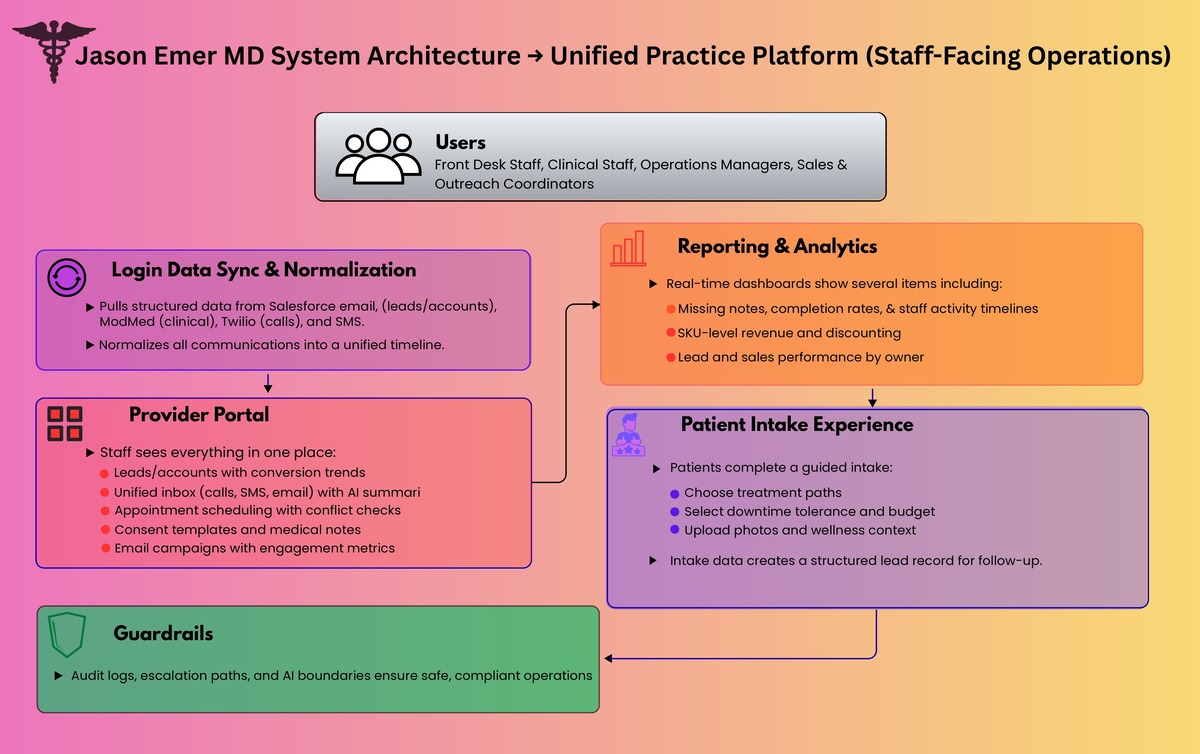
Solution 1: The unified practice platform
What the team sees: one place to run the business
Leads and accounts. Leads and patients sync in from Salesforce and appear in views built for the clinic — leads by owner, conversion trends, and top procedures. A “no-cracks” layer flags any lead that hasn’t been contacted within a set window (say, 3 to 12 hours) so a manager can step in.
One inbox for every conversation. Texts, calls, and email history all land in a single view. Calls come with transcripts and short AI summaries, so staff can read what happened instead of digging through recordings.
Email campaigns. Staff can send outreach right from the platform and see sends, opens, and replies.
Operations. Scheduling that respects real-world constraints (like avoiding same-day appointments across town), reusable consent forms with completion tracking, patient notes, and pre-visit instructions sent ahead of each appointment type.
Reporting. A reports layer answers the urgent questions fast — like which notes are missing for a given period, and completion rates by status and owner.
Analytics. One dashboard shows what’s actually driving the business: performance by product and treatment, discounts and why they were given, each team member’s activity, and lead and sales trends by owner and time. Not generic charts — views built for how a clinic really runs.
What patients see: a guided intake
We built a branded intake flow that gathers the right details without feeling like a long form. A patient can:
- choose one of two paths
- point to focus areas on an interactive body map
- set how intense a treatment they want, and how much downtime they’ll accept
- share the basics (budget range, sensitivity, skin type)
- add wellness context if it’s relevant
- upload photos for context
- submit — which creates a lead for the team to follow up
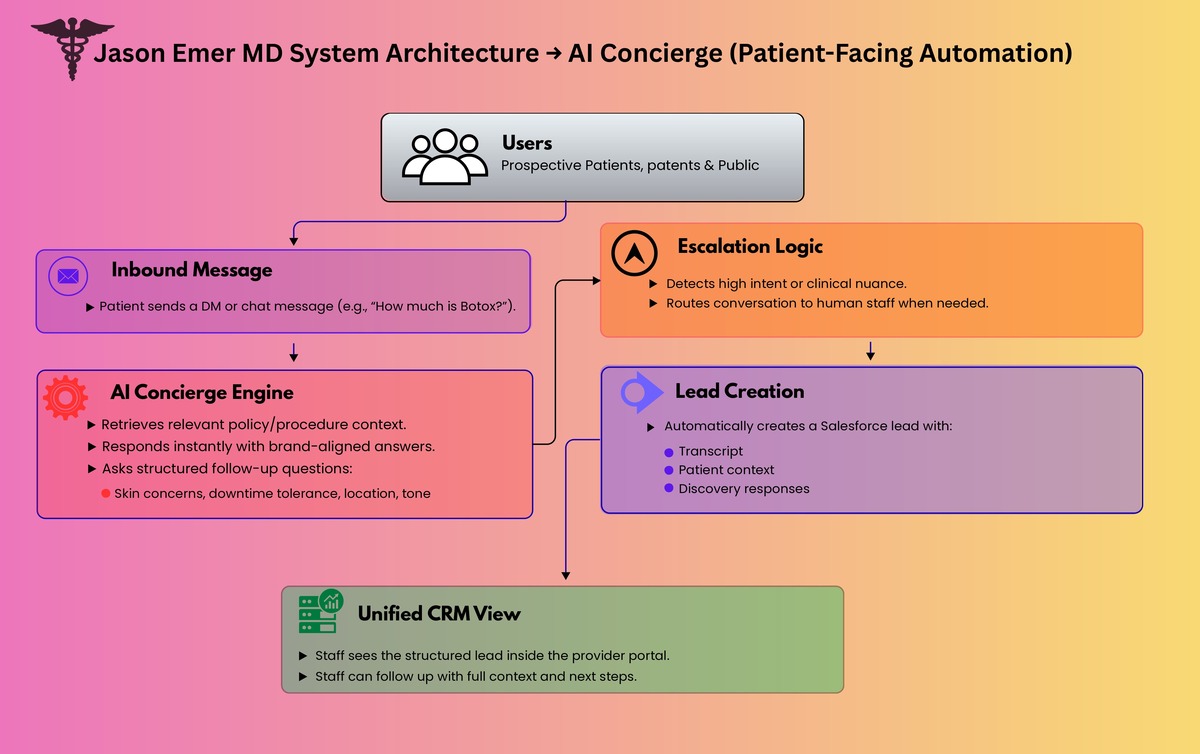
Solution 2: The AI concierge for Instagram and chat
Instagram is where modern aesthetic practices meet new patients — and it’s brutal to keep up with at scale. The concierge can:
- answer common questions instantly
- guide a patient through a real discovery conversation
- ask the right follow-ups (skin concerns, downtime, skin tone, location, and so on)
- stay in the practice’s premium, patient-first voice
- hand off to a person the moment things get high-intent or clinically sensitive
- create a Salesforce lead automatically when a patient asks to be contacted
That turns Instagram from a bottomless inbox into a real, qualified pipeline — with the context already attached.
Architecture Overview
Here’s how the pieces fit together, end to end.
1) The systems of record
- Salesforce as the backbone for leads, accounts, quotes, and ownership
- ModMed — their electronic health-records system — as the clinical source of truth
- Twilio (or similar) for phone calls and recordings
- ManyChat (or similar) as the Instagram gateway
2) Bringing it all together
- A scheduled sync pulls new Salesforce and operational records into the platform
- Calls, texts, and email are organized into one consistent timeline
- Clinical context is added where it helps, to give staff a fuller picture
3) The AI behind the scenes
- For calls: recording → transcript → who-said-what → summary → filed against the patient
- For chat: message → pull the right policy or procedure info → draft a reply → deliver it safely → log the transcript → create a lead when it makes sense
4) What people actually use
- The staff portal for running operations and reading the analytics
- The patient intake that organizes demand before it reaches the team
5) Guardrails
- A full audit log of every interaction
- Clear limits on what the AI is allowed to say
- A human handoff whenever it’s needed
Results and Impact
The numbers the practice saw:
- 15–20% more new leads, plus a 15% lift in conversion — attention on the web and social now turns into booked patients.
- 30% less labor time through automation — no more manual chasing, logging, and re-listening.
And in day-to-day terms:
- Minutes, not hours to understand a call, thanks to transcripts and summaries.
- Under a minute to respond on busy social channels, so attention turns into a real patient journey instead of a stalled message.
- Fewer lost leads, with alerts and manager visibility by owner and team.
- One clear system for appointments, consents, notes, and reporting.
- Better decisions, with revenue, product performance, discounts, and sales trends all in one place.
“What stood out most was their combination of speed, efficiency, and absolute transparency.”
— Head of Marketing, Jason Emer, MD · ★★★★★ Clutch review
Why It Worked
This wasn’t AI bolted onto a CRM. It was an operating-system approach:
- bring the clinic’s whole reality into one place — calls, texts, email, Instagram, scheduling, notes
- turn messy conversations into clear next steps
- keep Salesforce and ModMed as the systems of record, but finally make them usable day to day
- automate where it removes busywork, not where it adds risk
Krazimo helped Dr. Jason Emer’s practice grow patient engagement without losing the premium feel. By pairing one unified platform with an AI concierge that can handle a flood of inbound demand, the clinic gets faster responses, cleaner follow-ups, and real operational control — without ripping out the tools it already relied on.