




Impact
- Faster cycle time: Response time to insurer and TPA requests dropped from multiple days to a few hours, including verification.
- Higher returns: ~6 percent improvement in settlements through more consistent, persistent, standards backed defenses.
- Less manual work: About 45 hours saved per week for one restoration company.
- Net value: About 800k in projected annual impact, combining settlement lift plus hours saved.
- Big market leverage: This pattern scales across 3,000+ restoration companies in the US.
The problem
Restoration is backwards compared to most industries. The work starts immediately (flood, fire, mold), and only after the job is complete does the justification and invoicing battle begin. In practice, carriers and TPAs operate in a “delay, deny, defend” posture that forces restoration teams to prove every decision after the fact.
That proof burden is not simple paperwork. It requires technical precision across standards (IICRC S500, S520, plus state variations), job evidence (photos, moisture logs), and fast, consistent responses.
The core idea
Automation is only valuable here if it is credible. JSTFYD is built on one central insight: AI can accelerate and improve claim justification only when it is grounded in standards, job level evidence, and historical claim data, with outputs that remain reviewable and auditable.
What we built
JSTFYD combines three capabilities into one claims platform: standards grounded claim communication, claims aware project management, and estimate comparison plus validation tools.
In the product demo, these show up as dedicated modules (JSTFYD Studio, Compare Estimate, Projects, Inbox), built to match how restoration teams actually work day to day.
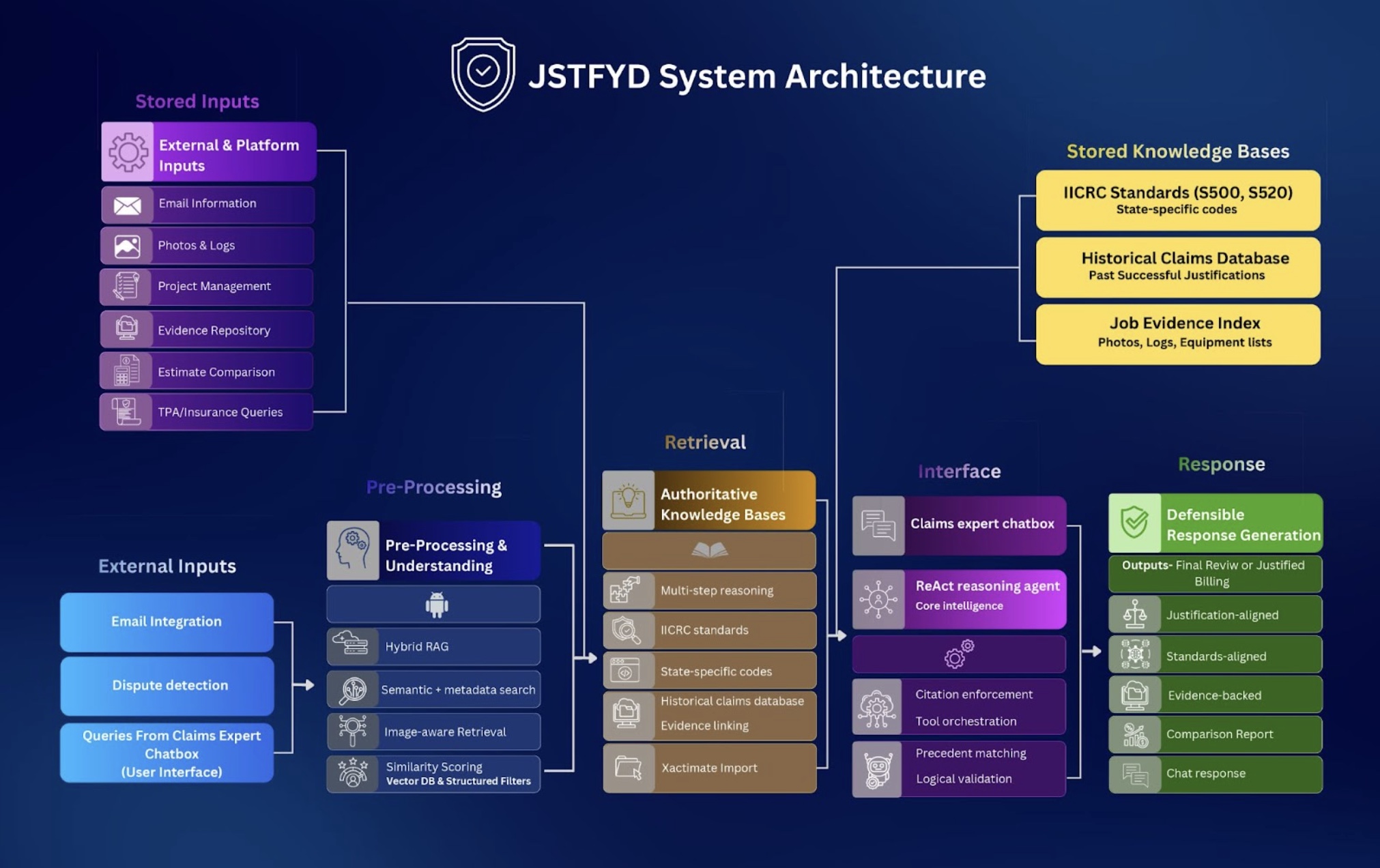
At a high level, the system is designed so every generated defense can be traced back to the right source material. Four architecture decisions matter most:
1) Hybrid retrieval that is meaning aware and citation accurate
Instead of relying on embeddings alone, JSTFYD uses hybrid retrieval that combines semantic similarity with structured metadata such as standard name, section and page number, document type, and categorized summaries of uploaded items.
This is what keeps citations precise when the dispute hinges on exact standard language.
2) Image aware evidence retrieval
Every uploaded photo is converted into a short description, vectorized, and stored with metadata so it can be retrieved as evidence during a dispute.
The document’s example is explicit: if an insurer challenges equipment placement, the system can retrieve the relevant room photo and use it directly in the response.
3) A ReAct style agent for multi step claim reasoning
A single agent orchestrates tool calls across standard lookup, image retrieval, evidence compilation, response drafting, and email formatting, which is important when one dispute touches multiple standards and multiple pieces of job evidence.
4) Citation enforced replies, plus precedent
Every justification email cites the relevant IICRC or state standard, references uploaded evidence, and links comparable past claims.
JSTFYD also indexes past restoration jobs and retrieves precedents when insurers challenge similar usage again, strengthening consistency over time.
How the workflow runs in practice
Workflow A: Set up a job once, then reuse the evidence forever
JSTFYD structures each job as a project, where teams upload invoices, photos, moisture logs, technician notes, equipment lists, and any supporting evidence.
In the demo, the project flow operationalizes this with a guided intake that asks for required documentation like moisture logs and an Xactimate estimate, with optional photo logs and additional documents.
Workflow B: Dispute email in, defensible draft out
JSTFYD integrates with existing email workflows so teams do not have to change how they communicate. When a dispute email arrives, the platform triggers the justification engine.
In the demo, this appears in the Inbox as claim threads tied to projects, with one click email draft generation. The goal is simple: a faster turnaround, with a response that is grounded in standards and supported by job evidence.
Workflow C: Estimate reductions, compared and rebutted line by line
Insurers often send reduced estimates, sometimes dramatically lower, hoping the restoration company accepts them.
JSTFYD’s comparison engine takes the original Xactimate estimate and the insurer’s revised version, highlights removed or reduced line items, explains why they matter, references standards to defend them, and compiles everything into a ready to send email.
In the demo, this is exposed as a Compare Estimate view that shows line items side by side, flags detected changes, and generates a written justification per item.
Workflow D: Validation before sending
Before any invoice or justification email is sent, the system checks that required evidence is present, verifies alignment with standards, confirms documentation completeness, and flags missing photos or logs.
This prevents weak packets from going out and reduces rework, especially for newer staff.
An expert in your pocket for the whole team
Not everyone at a restoration company is fluent in standards or dispute strategy. JSTFYD includes an AI powered claims expert chat that understands IICRC standards, state specific regulations, the full project data, the invoice and evidence, dispute history, and past claim precedents.
This reduces dependence on scarce internal specialists and helps teams get better at documentation and rebuttals over time.
Why the outcomes moved
The doc summarizes the operational drivers clearly: faster responses, fewer communication delays, reduced manual email workload, and fewer disputes because well supported justifications close arguments faster.
That is the mechanism behind the business outcomes you care about: speed, higher settlement consistency, and large weekly labor savings that compound at scale.
JSTFYD turns a chaotic, adversarial workflow into a structured, defensible, and scalable process by grounding AI in IICRC standards, structured evidence, hybrid retrieval, and precedent.
The result is not “AI that writes emails.” It is a claims system that helps restoration companies secure what they rightfully earned.