




Impact
- ~80% reduction in average hours spent while translating technical documents, without appreciable loss in translation quality (AI was able to flag areas that required human translators with high accuracy).
- Format preserved end to end: Documents are translated and returned in the same file format and structure that users upload, reducing manual rework.
- Business ready control: Users can tailor translations with domain and writing style controls so output matches professional context.
Client overview
LinguaCore is a GenAI based translation product built for professional workflows, including professional linguists, translation companies, and localization teams, with an emphasis on subject specific, context aware translation.
The problem
Professional translation businesses hit three scaling limits quickly:
- Cost does not scale: High quality technical translation becomes expensive when every page requires full human effort.
- Documents are not just text: Technical files contain structure and formatting that must survive translation, or teams lose hours rebuilding layouts.
- Context matters: Accurate translation is not enough; the output must match domain conventions and the intended tone for business use.
Goals
- Provide an end to end product for text and document translation.
- Preserve formatting and file structure for document outputs.
- Support domain and writing style controls to make translations usable in professional settings.
- Reduce operating costs while maintaining quality through targeted human review, guided by the AI.
The solution
LinguaCore delivers subject specific, context aware translations for professional users, with an optional human review layer when needed.
The product supports both text translation and document translation, with outputs designed to be immediately usable rather than requiring manual cleanup.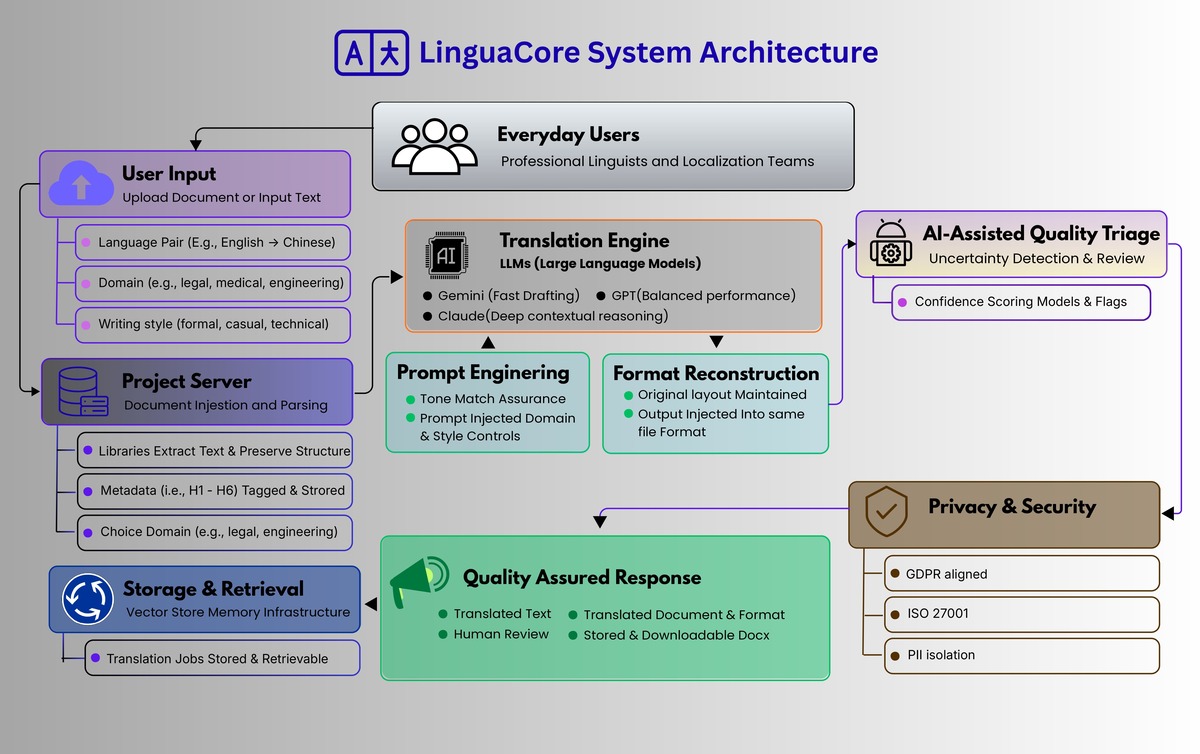
Architecture overview
1) Two pipelines, one consistent experience
LinguaCore supports two core translation paths:
- Text translation, optimized for fast iteration and business communication.
- Document translation, optimized for structured files where preserving layout, formatting, and file type is critical.
2) Format preserving document translation
For documents, the system must handle more than language conversion. It must:
- Ingest and parse the file while retaining structural elements
- Translate text segments while keeping context intact
- Reconstruct the document so the translated file preserves the original format and layout
This is what allows customers to receive translated manuals, PDFs, and business documents without a separate formatting pass.
3) Quality control that makes cost scale
For technical documents, LinguaCore’s core efficiency gain comes from AI assisted quality triage:
- The AI produces a translation draft
- The AI self flags uncertain or high risk segments
- Human reviewers focus only on flagged portions
This selective review loop is the mechanism behind the reported 80 percent plus reduction in operating costs without an appreciable loss in quality.
4) Privacy and security posture
LinguaCore’s privacy policy states it processes personal data under GDPR aligned requirements and references ISO 27001:2013 as an information security standard guiding its security approach.
How it works
Flow A: Text translation
- User enters text
- User selects language pair plus domain and writing style controls
- System generates a translation that matches the chosen context
Flow B: Document translation with formatting preserved
- User uploads a document
- User selects languages plus domain and writing style controls
- Translation runs as a job and is stored for retrieval
- User downloads the translated document in the same format, with layout retained
Flow C: Targeted human review for technical content
- AI translates the document
- AI flags segments likely to need expert review
- Reviewer validates and edits only those segments
- Final version is delivered with high quality at dramatically lower operating cost
Conclusion
LinguaCore modernizes professional translation by combining context controlled generation, format preserving document translation, and a pragmatic quality loop where AI does the heavy lift and humans intervene only where the system signals it is necessary. The result is a translation workflow that scales economically without sacrificing the standards professional customers expect.