




Impact
- Fully automated the “basic questions” layer across industries, so routine calls no longer require staff time.
- Human involvement dropped as low as 2-3% for businesses with simple, repeatable workflows such as restaurants.
- Consistently faster responses and fewer missed calls, because the agent can answer immediately, every time, including after hours.
The problem
Most businesses still run on phones. Reservations, order status, lead intake, scheduling, and support all come through voice. But traditional phone automation is either rigid (IVR trees) or fragile (scripts that break the moment a customer says something unexpected). Modern voice AI is powerful, but adoption fails for three predictable reasons:- Businesses do not just need a voice. They need actions: bookings, lookups, updates, routing, and follow ups.
- Telephony is a real stack: phone numbers, routing, call logging, and reliability are non negotiable.
- Every business has slightly different workflows, so generic agents collapse in the details.
Our Solution
The key idea
Voice AI becomes valuable only when it is deployed as a workflow engine, not a talking demo. Blink Concierge was built to make voice agents act like trained staff members by combining:- Telephony native infrastructure
- A workflow and tool calling layer
- A model agnostic voice layer
- White glove deployment for real integrations and edge cases
What We Built
- Contact management and call initiation
- Agent creation and configuration (prompt plus first message as the core primitive)
- Phone number provisioning and assignment of an agent to a number
- Call history with transcript, summary, and recording
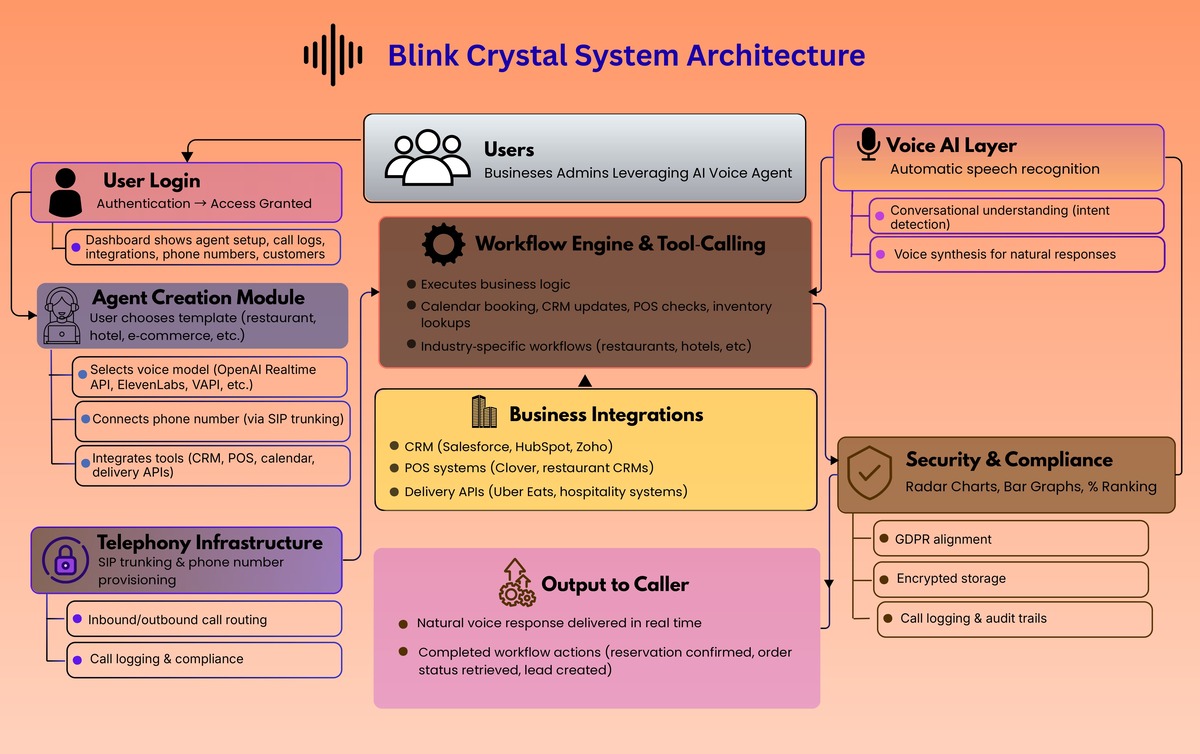
Architecture overview
The system breaks into four layers that work together.1) Telephony layer
This is the foundation. The platform provisions phone numbers, routes inbound calls to the right agent, and captures call artifacts (recordings, transcripts, summaries). This is what turns “AI voice” into an actual business phone system.2) Agent layer
Agents are defined as configurable entities with:- A system prompt that encodes role, policy, and workflow behavior
- A first message that sets tone and call opening behavior
3) Workflow and tool calling layer
This is the differentiator. The agent is not only conversational. It can trigger actions such as:- Creating reservations or appointments
- Updating CRM records
- Looking up order status
- Routing or escalating calls
- Capturing structured intake data for follow up
4) Model agnostic voice layer
The platform is designed to support multiple voice providers, so clients can choose based on realism, latency, cost, or vendor preference, without rewriting workflow logic. The agent logic stays stable while models evolve.How it works end to end
Flow A: Create and deploy an agent
- Create an agent (prompt plus first message)
- Assign it to a phone number
- Turn on routing so inbound callers reach the agent instantly
- Review call history artifacts to iterate quickly
Flow B: Run calls as workflows
- Caller states intent in natural language
- Agent identifies the workflow path
- Agent executes tool calls (book, look up, create, update)
- Agent confirms outcomes and closes the loop
- Platform stores transcript, summary, and recording for QA and training
Flow C: Human in the loop only when needed
Blink Concierge is designed to automate routine questions completely, then escalate only when:- A workflow falls outside the configured policy
- The caller request is ambiguous or sensitive
- A tool call fails or requires human judgment
Where it shines
- Restaurants: reservations, pickup and delivery status, menu questions, hours, basic routing
- Hospitality: after hours requests, basic service routing, simple bookings
- E commerce: order lookup, shipping status, returns initiation, ticket creation
- Real estate: lead qualification, scheduling, routing to agents
- Sensitive industries: structured intake plus careful escalation policies