




Impact
- Faster ramp for new reps by letting them simulate dozens of realistic calls before they speak to a real customer.
- Higher win rates driven by stronger discovery and objection handling, reinforced through repeatable practice and feedback loops.
- Scalable coaching without manager burnout, because the platform automates analysis and surfaces gaps instead of relying on manual review.
Client overview
PitchMee is an AI driven sales training and performance platform built for high velocity teams, combining simulation, peer roleplay, and real meeting analysis into one system.The problem
Sales teams have a training problem that most tools never solve:- Practice is inconsistent, hard to schedule, and rarely feels like real buyer pressure.
- Feedback is often subjective, delayed, or based on too small a sample of calls.
- Managers cannot realistically coach every rep while also running the sales pipeline.
- Real sales calls are where deals are won or lost, but they often go unreviewed at scale.
Goals
- Create a training loop that is interactive, not slide based.
- Make coaching measurable, not vibes based.
- Give managers team wide visibility without needing to listen to everything.
- Let teams practice in multiple modes: AI simulations, peer roleplays, and real meeting intelligence.
The solution
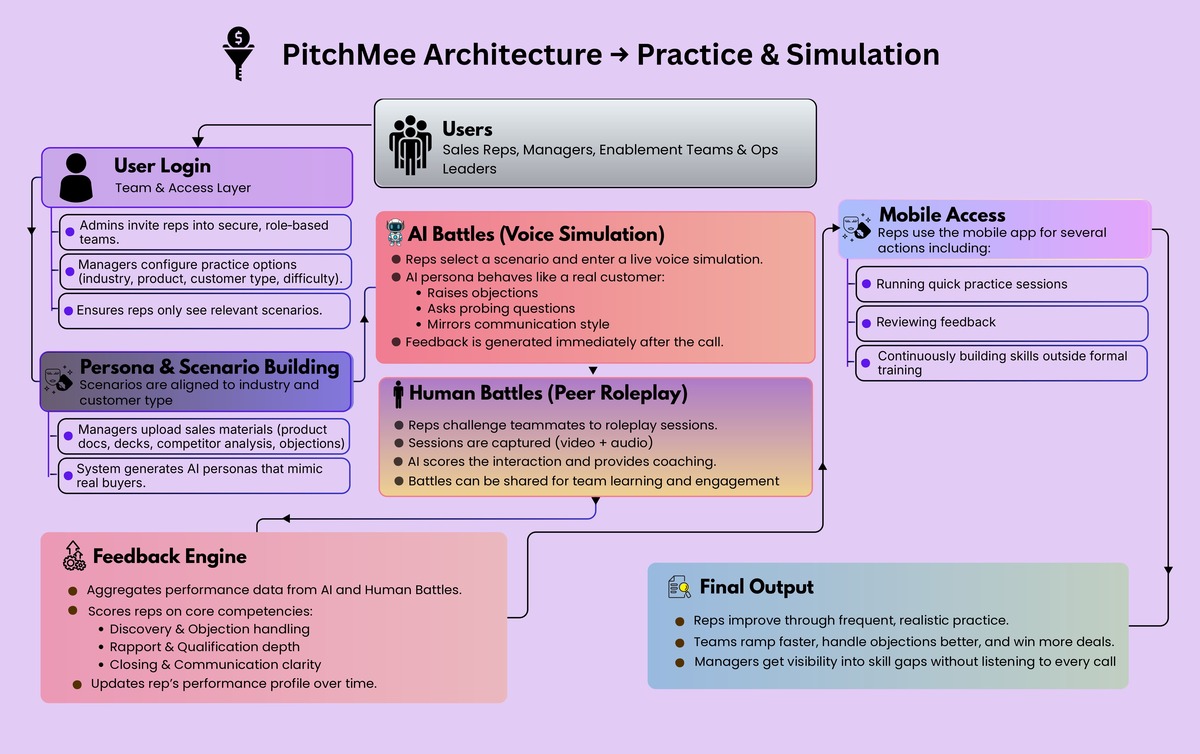
PitchMee is built around three reinforcing systems:- AI Battles: simulated voice calls where reps pitch to an AI persona acting as a real customer, including objections and industry specific behavior.
- Human Battles: peer to peer roleplay captured as video and audio, then scored with AI generated coaching.
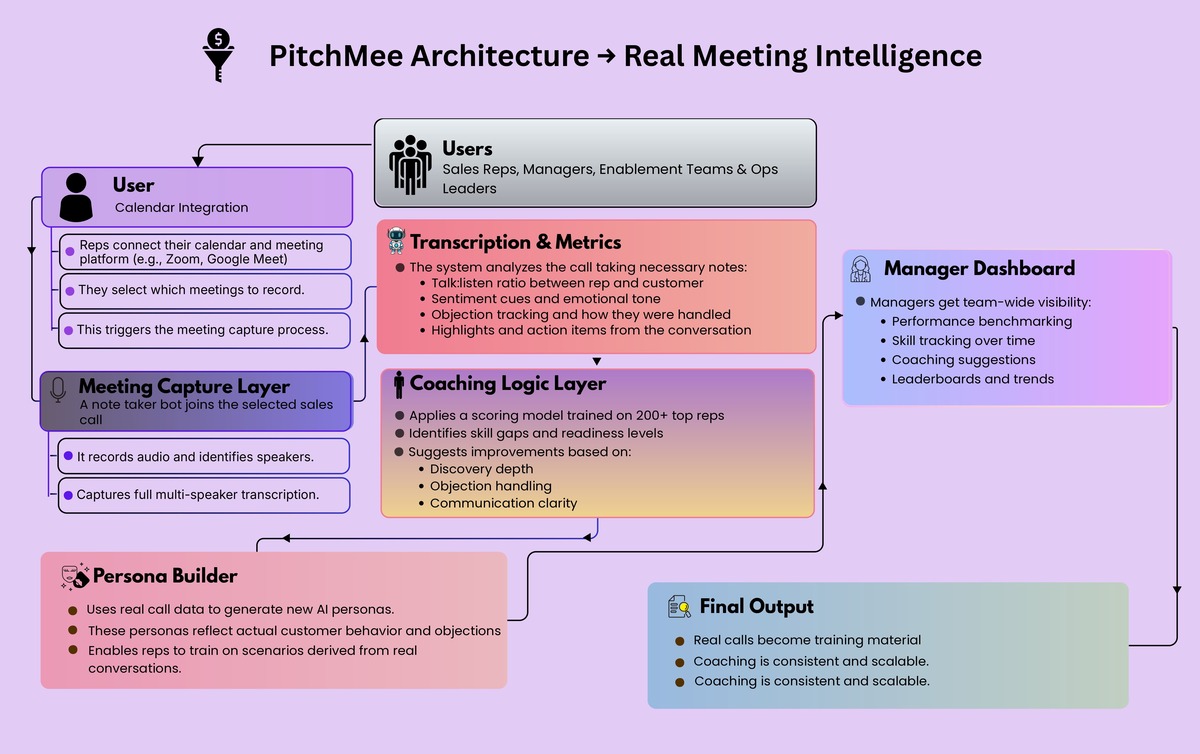
- Meeting Analysis: a note taker joins real sales calls, records them, and produces transcripts, scores on talk:listen ratio, highlights, sentiment cues, and objection tracking.
How it works end to end
Flow A: AI Battles
- Rep selects a scenario configuration (industry aligned presets, customer type, difficulty).
- Rep enters a live voice simulation with an AI buyer persona.
- After the call, PitchMee generates feedback and updates the rep’s performance profile over time.
Flow B: Human Battles
- A rep challenges a teammate to a roleplay based on a chosen configuration.
- The battle is captured (video and audio), then scored and reviewed with AI generated coaching.
- Battles can be shared within the team for lightweight engagement and learning culture.
Flow C: Real meeting analysis
- User connects calendar and meeting system, and selects meetings to record.
- Note taker joins and records the call.
- PitchMee produces transcript, metrics, highlights, sentiment cues, and objection handling guidance.
- Managers can use real calls to generate new training personas, turning actual field conversations into repeatable practice.
Architecture overview
PitchMee is best understood as five layers:1) Team and access layer
- Invite only teams, with role based access (admins can see both manager and user experiences; members focus on practice).
- Team level configuration that controls what practice options are available (industry, product categories, customer types, difficulty presets).
2) Real time voice simulation layer
AI Battles are voice first (not chat). Under the hood, PitchMee uses the OpenAI Realtime API so the AI can behave like a buyer in a live conversation: asking probing questions, challenging assumptions, raising objections, and mirroring communication styles.3) Persona and scenario building layer
Managers can build custom AI personas for their teams by uploading materials like product docs, sales decks, competitor analysis, and objection lists. The system then constructs a persona that understands the product, mimics the buyer, and adapts based on rep responses.4) Meeting capture and analysis layer
For real calls, PitchMee inserts a note taker into sales meetings and generates:- multi speaker transcription
- rep vs customer talk time separation
- talk to listen ratio scoring
- highlights and action items
- sentiment and tonal cues
- objection tracking and suggested improvements
5) Feedback, dashboards, and mobility
- A feedback engine that scores core competencies such as discovery, objection handling, rapport, qualification depth, closing, and communication clarity, with results aggregated over time.
- A manager dashboard that consolidates battles, meetings, benchmarking, skill scoring, trend analysis, leaderboards, and coaching suggestions.
- A mobile app so reps can run quick practice sessions, review feedback, and build skill continuously, not quarterly.
Results
In early deployments, PitchMee has delivered:- Faster onboarding and ramp for new reps.
- Higher win rates driven by improved discovery and objection handling.
- Consistent coaching at scale with reduced manager load.
- More confident teams and healthier learning culture through frequent practice and peer competition.
Lessons learned
- Voice based simulations create more realistic pressure and better learning than text prompts alone.
- Coaching must be structured and data driven to scale beyond a single great manager.
- Short, frequent practice changes behavior faster than occasional training workshops.