Legal AI You Can Trust

The Problem

Legal work is an information game. Dense documents, moving statutes, and jurisdiction-specific nuance. But unlike most “knowledge work,” the cost of getting it wrong isn’t a mild embarrassment. A confident hallucination can create real legal and business consequences. 

That’s the gap Case Logic was built to close: a secure, state-aware AI legal companion engineered to produce grounded outputs that legal professionals (and everyday users) can actually rely on. 

Why generic AI breaks in legal (and what we did instead)

Most general-purpose AI assistants stumble in legal settings for a few predictable reasons:

  • Hallucinations are unacceptable in high-stakes workflows.
  • Law is jurisdiction-specific—state-by-state differences matter, making it harder to aggregate information.
  • Web search can’t guarantee credibility or freshness for legal decisions.
  • Legal workflows need multiple specialist “minds,” not one chatbot (paralegal, co-counsel, judge-style critique).
  • Case data must remain private, organized, and persistent—not scattered across stateless chat threads. 

Our Solution

So we took a different approach:

Trustworthy legal AI requires domain-specific grounding, multi-agent reasoning, and rigorous verification—not just a powerful model.

The high-level system: “trust” is an architectural feature

Case Logic is intentionally modular: a case workspace, retrieval engine, specialist agents, and a two-layer safety system all with compliance scoring and strong data boundaries.

Let’s start with an overview of the core components.

Case Workspace = the unit of context

Users work inside persistent case spaces designed for real legal workloads: multi-document uploads (leases, filings, discovery), version tracking, and continuity across conversations—so you’re not re-explaining context every time.

Legal-grade Retrieval (RAG) that prioritizes relevance

Accuracy starts before generation. Case Logic uses a RAG pipeline with re-ranking that narrows 500+ candidate chunks to ~50 highly relevant ones—so the model reasons from the best evidence.

Documents live in a global vector store but are isolated using strict case metadata, so retrieval stays inside the correct workspace boundary.

Multi-agent legal workspace (specialists, not a monolith)

Instead of one “assistant,” Case Logic uses four specialized agents:

  • Lawyer Agent (direct questions + client-like scenarios) 
  • Paralegal Agent (summarization, extraction, document review) 
  • Co-Counsel Agent (strategy + deeper analysis) 
  • Judge Agent (stress-testing arguments + weaknesses)

All of them work over the same grounded retrieval layer, but with role-specific instructions—so the system can shift modes depending on what the user needs. 

The two-layer safety system (the “no made-up stuff” guarantee)

Case Logic doesn’t hope the model behaves. It forces verification.

Safety Layer 1: Citation-enforced reasoning

Every substantive response must cite the retrieved source chunks. If the system can’t find grounding for a claim, it must refuse. 

Safety Layer 2: Reflection + verification (quality control)

After the response is drafted, a secondary reflection agent reviews it for unsupported claims, missing citations, ambiguity, logic gaps, or inconsistencies with the retrieved text. 

Together, citation enforcement + reflection create a dual barrier designed specifically for legal risk. 

Compliance checking: turning “review” into a scored workflow

One of the highest-ROI components is the Compliance Checker. It analyzes documents like leases, agreements, NDAs, and policies to flag missing clauses, risky language, outdated references, and inconsistencies—then outputs recommendations plus a compliance confidence score from 0–100

This is where legal AI stops being a “chat tool” and becomes a business system: less review time, lower risk exposure, better document quality. 

Model flexibility without compromising safety

Different tasks benefit from different LLM strengths, so Case Logic supports switching models while keeping the safety architecture stable (e.g., Gemini for drafting, Claude for deep reasoning, GPT for balanced performance). 

Security & governance: legal data needs hard boundaries

Legal data is sensitive by default. Case Logic’s design emphasizes encrypted storage, PII isolation, strict workspace boundaries, and deletion when users remove cases/documents. 

The Case Logic Workflows

Upload resources (legal professional)

User action: A lawyer/paralegal uploads case materials (leases, contracts, filings, discovery, exhibits) into a persistent case workspace

Behind the scenes:

  1. Workspace binding + isolation: The upload is associated to the active case, and the system enforces per-case metadata isolation in the vector store.
  2. Chunking + indexing: The document is chunked and indexed into the global retrieval layer, but tagged by case ID.
  3. Secure storage + governance: Data is stored with encryption and strong boundaries (PII isolation, workspace-level boundaries), and supports deletion when users remove cases/documents.
  4. Optional compliance pass: For certain doc types (leases, NDAs, policies, agreements), the Compliance Checker can flag missing clauses/risky language and produce a 0–100 confidence score plus recommendations.
  5. Continuity is automatic: Future chats and agent interactions stay tied to that case—so the user doesn’t have to re-explain context every session.

Legal Query (professional, with uploaded docs)

User action: They pick an agent (Paralegal / Co-Counsel / Judge / Lawyer) and ask a question about the case. 

System flow:

  1. Retrieve only from the active workspace context: Even though the store is global, retrieval is constrained to what’s relevant to the user’s active case/workspace via case metadata.
  2. High-precision reranking: The RAG pipeline pulls 500+ candidates and a neural reranker filters down to the top ~50 most relevant chunks.
  3. Draft answer with forced grounding: The agent must cite all assertions, and must refuse if it can’t find relevant grounding.
  4. Second-pass verification (QC): A reflection layer checks for unsupported claims, missing citations, ambiguity, logic gaps, and inconsistencies with retrieved text.
  5. Deliver output + next actions: The response can feed into drafting/summaries and exports (PDF/Word) within the case workflow. 

General Query (layperson, no uploads)

User action: They ask a question like “What are my tenant rights in Pennsylvania?” and consult the Lawyer Agent for preliminary guidance. 

System flow (no uploads required):

  1. State-aware retrieval over public corpora: The system can pull from public legal corpora (and continuously ingest updates as laws evolve).
  2. Rerank for relevance: Same retrieval stack—candidates → reranked top set for the model to use. 
  3. Citation-enforced response: The assistant must include references and refuse if it cannot ground the answer. 
  4. Reflection verification: A second agent checks the response quality and grounding before it reaches the user. 

What it unlocks in practice

A few concrete examples from the system design:

  • Lease review: A tenant uploads a 40-page lease. Case Logic flags missing disclosures, inconsistent clauses, and high-risk language—then scores the document and proposes fixes.
  • Case prep for lawyers: An attorney uploads exhibits, state statutes, and filings. The co-counsel agent helps build strategy; the judge agent stress-tests arguments provided.
  • Everyday legal questions: A user asks about state-level tenant rights. The lawyer agent retrieves verified statutes and provides grounded, citation-backed answers.

The takeaway

Legal AI must be more than a chatbot. It has to be state-aware, grounded, verifiable, and secure—with workflows that match how legal work really happens. 

Case Logic is built around a simple belief: when it comes to legal AI, trust can’t be left to the model, it has to be built into the architecture.

Blockchain Exploration as Easy as Asking

The problem

Blockchains generate an enormous amount of activity every few seconds: transfers, swaps, mints, burns. All of this is technically public, but in practice, most people can’t access it. Why?

  • The data comes in raw, encoded formats that require deep technical knowledge (ABIs, RPC calls, event decoding).
  • Analysts have to build custom indexers or wrangle rigid dashboards that only answer a narrow set of questions.
  • For non-developers, the barrier is even higher — turning blockchain’s “open data” into real-world insights is nearly impossible.

And with the recent rise of Layer-2 (L2) chains like Base, Optimism, and Arbitrum, the challenge has only grown. L2s are designed to scale Ethereum by batching and processing transactions faster and cheaper — but that means the raw data volume is exploding. On Ethereum mainnet, activity was already complex; on L2s, we now see multiples of that load, every second. Some even operate on “optimistic” assumptions (treating transactions as valid until proven otherwise), which further accelerates throughput.

This creates a paradox: blockchains are the most transparent systems ever built, yet the insights remain inaccessible to most of the people who need them — investors, builders, researchers, even everyday token holders.

Goals

  • Natural language → Cypher, safely and consistently
  • Multi-tenant subgraphs, with strong isolation and access control
  • Real-time UX, including streaming responses and step visibility
  • A scalable operating model for subgraph creation, lifecycle management, and monetization (credits, subscriptions)

Our Solution                    

We engineered the GraphAI Chat Interface as a production-grade system around two core ideas:

  1. Clean subgraph boundaries so answers stay relevant and trustworthy.
  2. A tool-driven agent that can plan, query, recover from errors, and synthesize results into human-readable responses.AI Blockchain

How It Works

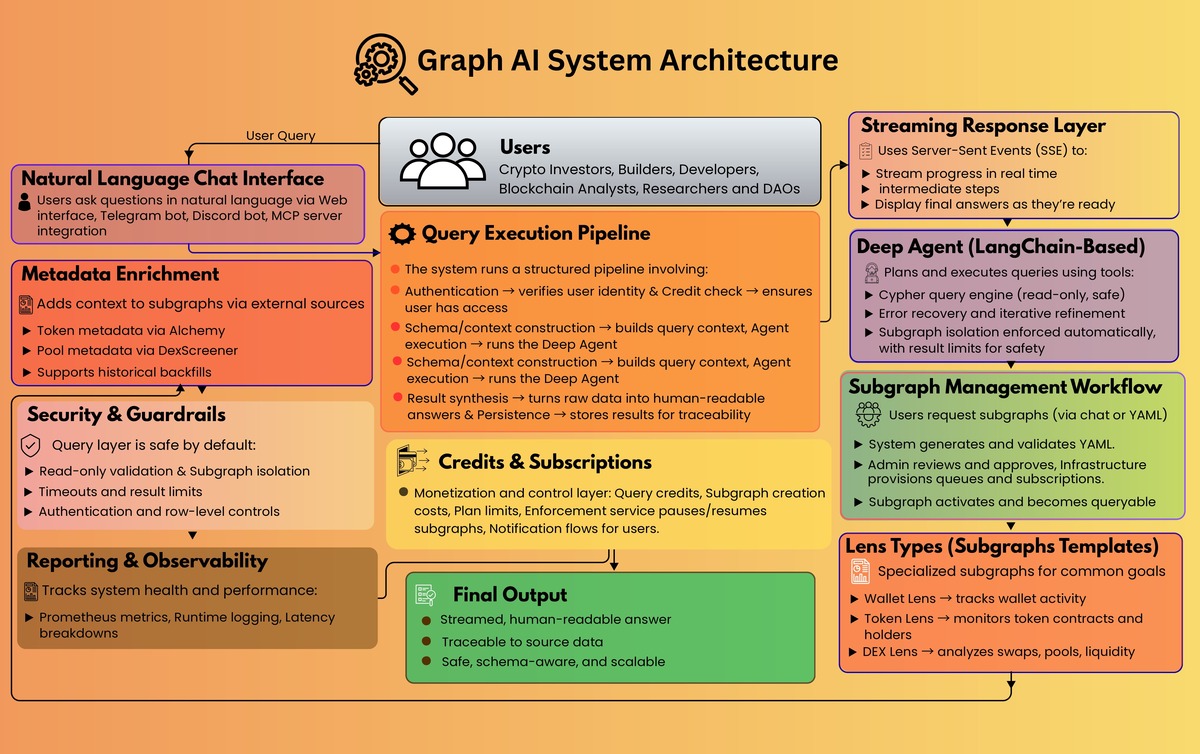
1) Query Execution Pipeline

When a user asks a question, the platform runs a structured pipeline: authentication, credit checks, dynamic schema and context construction, agent execution, result synthesis, and persistence. 

2) Streaming Responses (SSE)

Instead of making users wait for a single final answer, GraphAI streams progress in real time using Server-Sent Events, including status updates, intermediate agent steps, parallel tool executions, and the final response. 

3) Deep Agent (Tool-Based Reasoning)

At the core is a LangChain-based “Deep Agent” that can do multi-step planning, parallel execution, and iterative refinement when errors occur. 

The agent’s primary capability is a read-only Cypher execution tool with guardrails:

  • Blocks write operations (CREATE, MERGE, SET, DELETE, etc.)
  • Automatically enforces subgraph isolation
  • Limits results to keep queries safe and predictable

Subgraphs: From Request to Live Data

GraphAI isn’t just “chat over a database.” It includes an operational workflow for creating and managing subgraphs:

  • Users submit a request (natural language or YAML)
  • YAML is generated and validated
  • Admin review approves or rejects
  • Infrastructure provisioning creates queueing and subscriptions
  • The subgraph activates and becomes queryable

The system supports core on-chain event types (transfers, swaps, mints, burns, native transfers), plus configurable backfills for historical data.   

It also automatically enriches subgraphs with token and pool metadata via external sources (for example, token metadata via Alchemy and pool metadata via DexScreener). 

“Lens” Design: Purpose-Built Subgraphs

To make subgraphs easier to configure correctly, we implemented specialized lens types optimized for common analysis goals:

  • Wallet Lens: wallet-centric activity and monitoring
  • Token Lens: token contract activity and holder patterns
  • DEX Lens: pool activity, swaps, and liquidity behavior  

Platform Features That Make It Deployable

Credits and Subscriptions

GraphAI includes a built-in monetization and control layer (query credits, subgraph creation costs, and plan limits). 

A background enforcement service can pause and resume subgraphs automatically based on subscription status and limits, including notification flows. 

Multi-Channel Access

Beyond the web interface, GraphAI supports:

  • Telegram bot experiences (mobile-first querying)
  • Discord bot experiences (slash commands, mentions, rich embeds)
  • MCP server integration, exposing GraphAI tools to other AI applications

Observability and Reliability

The platform ships with Prometheus metrics, runtime logging, and latency breakdowns so the system can be tuned like a real production service. 

Security and Guardrails

GraphAI’s query layer is designed to be safe by default: read-only validation, enforced subgraph isolation, timeouts, result limits, authentication, and row-level controls. 

Outcome

GraphAI now has a modern foundation for “natural language blockchain analytics” that is:

  • Fast and understandable (streamed execution and synthesized answers)
  • Accurate by construction (subgraph isolation + schema-aware prompting)  
  • Operationally scalable (managed subgraph workflow, backfills, metadata enrichment)
  • Deployable as a business (credits, subscriptions, enforcement, notifications, bots, MCP)

From Sustainability Research to Decarbonization Plans

Impact

15 Rock wanted to scale decarbonization consulting without scaling headcount. This prototype compresses the slowest part of the workflow: turning scattered public and client data into a structured emissions and asset view, then producing a clear, defensible decarbonization plan with dashboards and a client-ready report.

Client overview

15 Rock is a sustainability consulting firm helping companies reduce carbon emissions while maintaining profitability. Their work requires analyzing operations, assets, and emissions drivers, then translating that into practical roadmaps.

The problem

15 Rock faced three bottlenecks:

  • Manual research: Collecting and summarizing company operations, assets, and emissions information across reports and sources was time-consuming.
  • Complex analysis: Effective strategies require linking emissions drivers to operational realities and financial constraints, not generic recommendations.
  • Limited scalability: Manual processes constrained the number of clients the team could support.

Goals

  • Build an AI prototype to automate research and accelerate analysis.
  • Support emissions and asset modeling to identify decarbonization opportunities.
  • Provide clear visualizations and a structured, client-ready report.
  • Keep the system modular for future expansion.

The solution

Krazimo built a prototype AI platform that streamlines 15 Rock’s consulting workflow:

  • Automated research: Collects and organizes information from public reports and documents.
  • Structured extraction: Converts unstructured disclosures into a usable fact base (assets, emissions signals, operational drivers).
  • Strategy generation: Identifies high-impact decarbonization levers tied to the company’s footprint.
  • Dashboards: Visualizes hotspots, assets, and recommended initiatives.
  • Report generation: Produces a structured plan that consultants can review and deliver.AI Report Generation for decarbonization

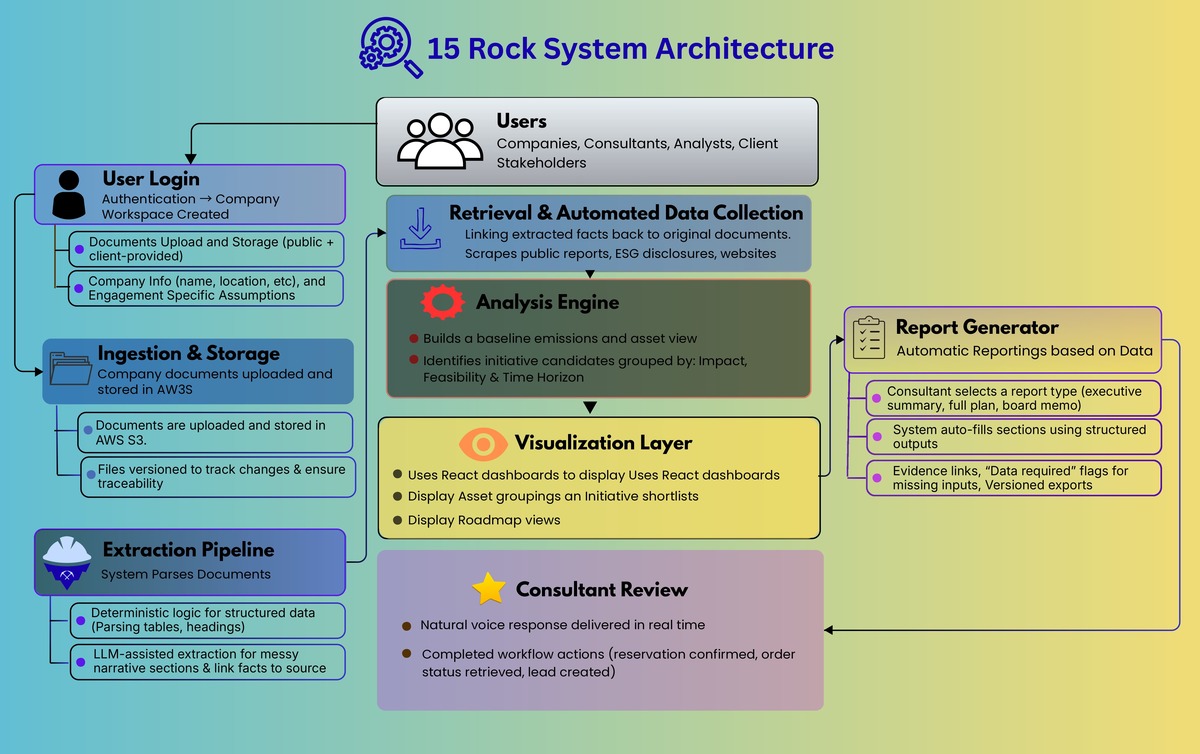
Architecture overview

The prototype follows a “workspace-driven” architecture:

  • Company workspace: A single place to store documents, extracted facts, assumptions, analysis runs, and outputs.
  • Ingestion and storage: Public and client-provided documents are stored in S3 with versioned artifacts.
  • Extraction pipeline: Combines deterministic parsing (tables, headings) with LLM-assisted extraction for messy narrative sections, producing structured outputs.
  • Retrieval layer: A document retrieval component grounds recommendations and enables traceability back to sources.
  • Analysis engine: Builds baseline emissions and asset views, then proposes initiative candidates grouped by impact, feasibility, and time horizon.
  • Visualization layer: React dashboards for exploring hotspots, asset groupings, initiative shortlists, and roadmap views.
  • Report generator: Creates a template-based deliverable populated from structured outputs, includes evidence links, flags data gaps, and supports versioning.

How report generation works

  1. Consultant selects a report template (executive summary, full plan, board memo).
  2. The system auto-fills sections from the latest baseline, hotspots, and initiative shortlist.
  3. Major claims attach references to source material; missing inputs become explicit “data required” callouts.
  4. Consultant reviews, edits, and approves.
  5. The platform exports and versions the final report with input provenance.

Implementation snapshot

  • Backend: Python (FastAPI), serverless execution via AWS Lambda
  • Storage: AWS S3 for documents and generated artifacts
  • Frontend: React dashboards
  • Data collection: Web scraping from public sources
  • Delivery: Prototype completed in ~4 months, designed for iterative expansion