

Impact
- Revenue up 23.5% — from $4.15M to $5.12M in a single year.
- Net profit up 358% — from roughly $445K to $2.04M, by winning more of what the team had already earned.
- Faster turnaround — replies to insurers and their claims handlers dropped from several days to a few hours.
- Less manual work — collections that used to take three people now takes one.
- Room to scale — the same approach works for the 3,000+ restoration companies across the US.
“From 2024 to 2025 our revenue grew from $4.15M to $5.12M (about 23.5%), but net profit grew from roughly $445K to $2.04M — a 358% increase.”
— Carlos Ramirez, Owner, Pure Restore · ★★★★★ Clutch review
The problem
Restoration works backwards from most businesses. The job starts the moment disaster strikes — a flood, a fire, mold — and the fight to actually get paid only begins after the work is done. Insurers, and the outside firms they hire to handle claims, tend to “delay, deny, and defend,” which forces restoration teams to justify every decision after the fact.
And that justification isn’t simple paperwork. It has to match the technical standards the whole restoration industry runs on — set by an industry body called the IICRC — and be backed by job evidence like photos and moisture readings, delivered quickly and consistently. Miss a detail, and the payment stalls.
The idea
Automation only helps here if it’s credible. So JSTFYD was built on one principle: AI can speed up and strengthen a claim only when it’s grounded in the real standards, the actual job evidence, and the company’s own past claims — and only when a person can still review and check every word.
What we built for Pure Restore
We built JSTFYD — one platform that handles the whole claims fight — for Pure Restore, a restoration company in Denver. It does three things: it writes claim responses backed by the standards, it keeps each job’s evidence organized, and it compares an insurer’s estimate against the original, line by line, to catch what’s been quietly cut.
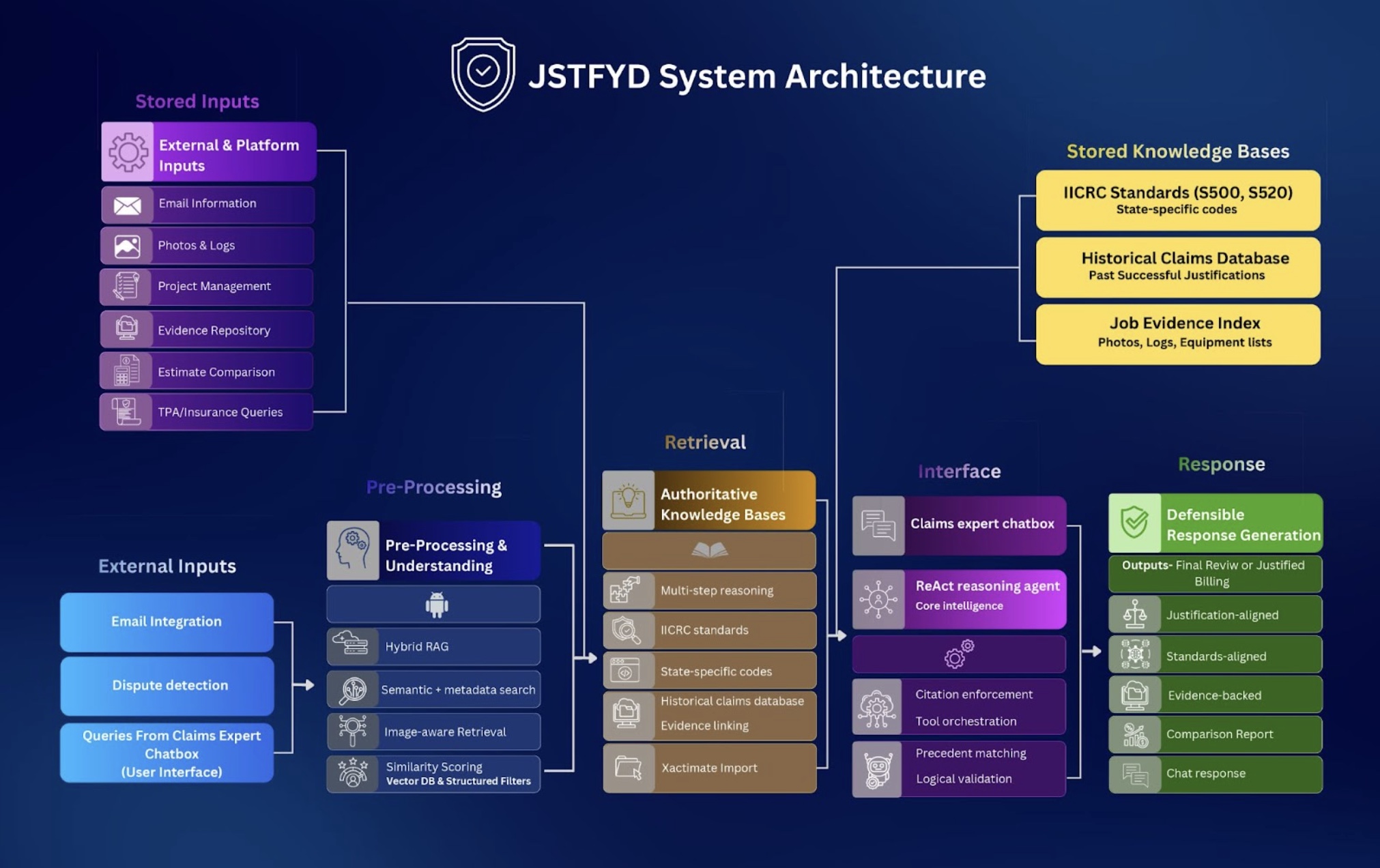
Underneath, everything is built so any response can be traced straight back to its source. Four ideas make that work:
1) It cites the exact standard, not a rough match
Instead of just finding text that looks similar, JSTFYD pins the precise standard, section, and page a claim depends on — so when a dispute comes down to exact wording, the citation is exact too.
2) The right photo pulls itself in
Every job photo is described and tagged the moment it’s uploaded, so it can be found later as evidence. If an insurer questions where equipment was placed, the system surfaces the relevant room photo and drops it straight into the reply.
3) One assistant handles the whole claim
A single AI assistant works a claim end to end — looking up the standard, finding the photos, gathering the evidence, drafting the response, and formatting the email. That matters when one dispute touches several standards and several pieces of evidence at once.
4) Every reply is backed, and learns from the last one
Each response cites the relevant standard, points to the uploaded evidence, and links to similar past claims. JSTFYD keeps a record of every job it has handled, so when an insurer challenges the same thing again, it answers on the same footing as before — and gets more consistent over time.
How it works day to day
Set the job up once, reuse the evidence forever
Each job lives as its own project, where the team uploads invoices, photos, moisture logs, technician notes, and equipment lists. A guided setup asks for the essentials — the moisture logs and the estimate (built in Xactimate, the industry-standard estimating tool) — so nothing important is missing when a dispute comes.
Dispute email in, ready-to-send reply out
JSTFYD plugs into the email the team already uses. When a dispute lands, it drafts a response — tied to the right job, grounded in the standards, and backed by the evidence — in one click. Same inbox, far faster turnaround.
Insurer cut the estimate? Rebutted line by line
Insurers often send back a lower estimate, hoping it just gets accepted. JSTFYD puts the original estimate next to the insurer’s version, highlights exactly what was removed or reduced, explains why each item matters, and writes the rebuttal — item by item — into a ready-to-send email.
A final check before anything goes out
Before a response or invoice is sent, the system confirms the evidence is there, the standards line up, and nothing is missing — so a weak claim never goes out the door. That’s a real safety net, especially for newer staff.
An expert in everyone’s pocket
Not everyone on a restoration crew is fluent in the standards or in claim strategy. JSTFYD includes a claims-expert chat that knows the standards, the local regulations, the full job file, the evidence, and the history of past claims — so the whole team can hold its own, and get better at it over time, without leaning on one or two specialists.
Why it worked
The drivers are simple: faster responses, fewer delays, far less manual email work, and fewer drawn-out fights — because a well-supported answer ends the argument sooner. That is what turned into the numbers up top: more revenue, healthier margins, and a claims process that no longer eats the team’s week.
JSTFYD turns a messy, adversarial process into a structured, defensible, and repeatable one — by grounding AI in the real standards, the real evidence, and the company’s own track record. It isn’t “AI that writes emails.” It’s a claims system that helps restoration companies collect what they have rightfully earned.