Author: Akhil Verghese
Automating CBSE Exam Grading with AI
Impact
- 60 percent reduction in grading time, giving teachers more time to teach and mentor.
- More consistent evaluation across students and graders, improving fairness and transparency.
- Actionable feedback for students, showing where marks were lost and how to improve.
Client overview
Arivihan is an edtech company focused on improving education outcomes in India. They set out to modernize how CBSE board exam style answers and mock tests are evaluated by automating subjective grading and feedback.The problem
CBSE style grading is high effort and hard to scale:- Subjective answers take time to evaluate, especially at school scale.
- Inconsistency is common, with different evaluators awarding different marks for similar answers.
- Growing test volume makes manual grading a bottleneck for schools and coaching programs.
Goals
- Build an AI powered grader for CBSE board exams and mock tests.
- Ensure grading is consistent and fair, aligned to a predefined marking scheme.
- Generate detailed, student-friendly feedback that explains deductions and improvement steps.
- Integrate cleanly into Arivihan’s existing platform via APIs.
The solution
Krazimo built a scalable AI grading system that takes in the question, expected answer structure, and marking scheme, then evaluates student responses to produce both marks and feedback. Key components:- Marking scheme based grading: Evaluates subjective answers against defined criteria, not vague similarity.
- Deduction explanations: Highlights where marks were lost and why.
- Personalized improvement guidance: Actionable suggestions aligned to the rubric.
- Reporting: Detailed student and teacher reports to track performance and identify common misconceptions.
- Integration APIs: Designed for drop-in use inside Arivihan’s edtech workflows.
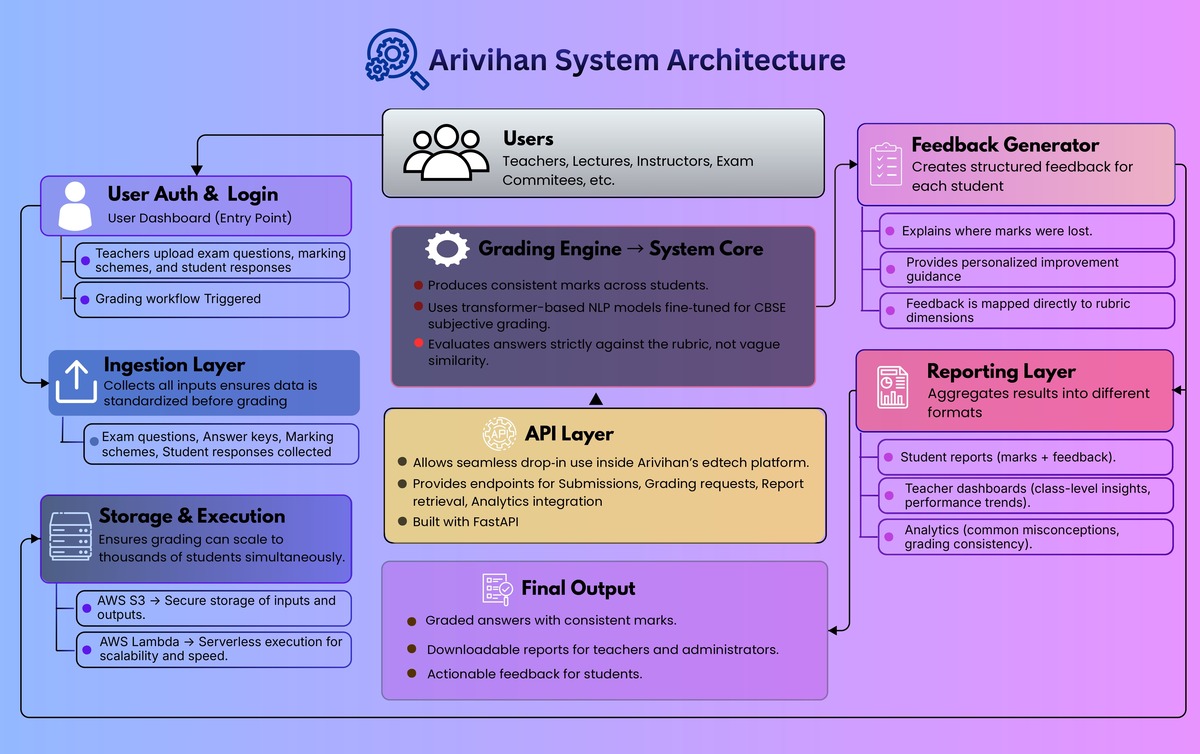
Architecture overview
- Ingestion layer: Accepts questions, answer keys, marking schemes, and student responses.
- Grading engine: Applies transformer-based NLP models fine-tuned for subjective grading, guided by the rubric and expected points.
- Feedback generator: Produces structured feedback mapped to rubric dimensions (what was missing, what was incorrect, what to do next).
- Reporting layer: Aggregates results for student reports, teacher dashboards, and class-level insights.
- API layer: FastAPI endpoints for submission, grading, report retrieval, and analytics.
- Storage and execution: AWS S3 for secure storage of inputs and outputs; AWS Lambda for scalable, serverless execution.
Implementation snapshot
- Backend: Python with FastAPI
- Execution: AWS Lambda
- Storage: AWS S3
- Modeling approach: Transformer-based NLP models fine-tuned for CBSE-style subjective grading
- Delivery timeline: 4 months
Outcome
The AI grader significantly improved Arivihan’s evaluation workflow:- Grading time dropped by about 60 percent.
- Evaluation became more consistent across students and test cycles.
- Students received clearer, more actionable feedback to improve future answers.
Protecting Your Intellectual Property: What Every Small Business Needs to Know
Paid Faster, Paid More – Revolutionizing Restoration
Impact
- Revenue up 23.5% — from $4.15M to $5.12M in a single year.
- Net profit up 358% — from roughly $445K to $2.04M, by winning more of what the team had already earned.
- Faster turnaround — replies to insurers and their claims handlers dropped from several days to a few hours.
- Less manual work — collections that used to take three people now takes one.
- Room to scale — the same approach works for the 3,000+ restoration companies across the US.
“From 2024 to 2025 our revenue grew from $4.15M to $5.12M (about 23.5%), but net profit grew from roughly $445K to $2.04M — a 358% increase.”
— Carlos Ramirez, Owner, Pure Restore · ★★★★★ Clutch review
The problem
Restoration works backwards from most businesses. The job starts the moment disaster strikes — a flood, a fire, mold — and the fight to actually get paid only begins after the work is done. Insurers, and the outside firms they hire to handle claims, tend to “delay, deny, and defend,” which forces restoration teams to justify every decision after the fact.
And that justification isn’t simple paperwork. It has to match the technical standards the whole restoration industry runs on — set by an industry body called the IICRC — and be backed by job evidence like photos and moisture readings, delivered quickly and consistently. Miss a detail, and the payment stalls.
The idea
Automation only helps here if it’s credible. So JSTFYD was built on one principle: AI can speed up and strengthen a claim only when it’s grounded in the real standards, the actual job evidence, and the company’s own past claims — and only when a person can still review and check every word.
What we built for Pure Restore
We built JSTFYD — one platform that handles the whole claims fight — for Pure Restore, a restoration company in Denver. It does three things: it writes claim responses backed by the standards, it keeps each job’s evidence organized, and it compares an insurer’s estimate against the original, line by line, to catch what’s been quietly cut.
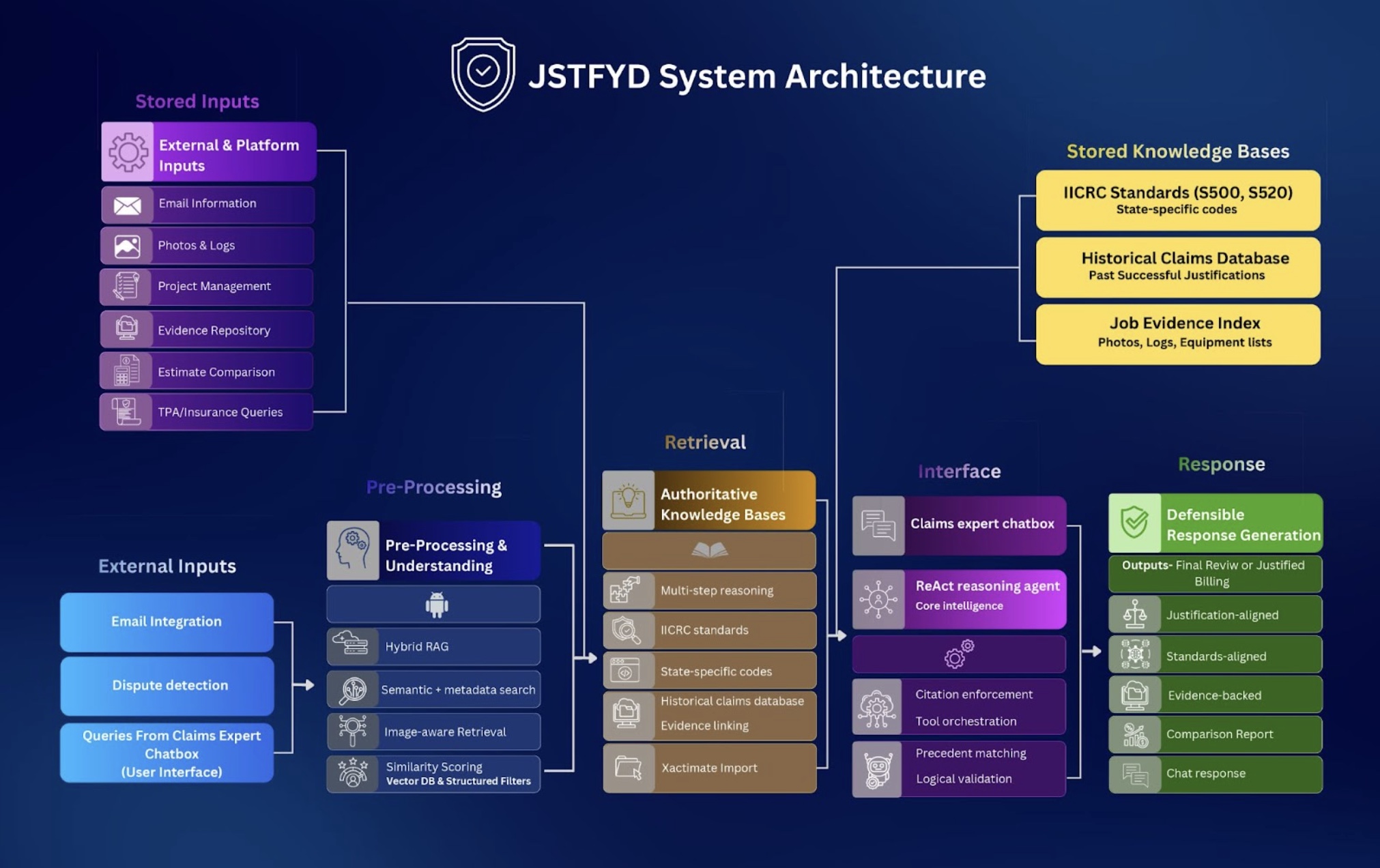
Underneath, everything is built so any response can be traced straight back to its source. Four ideas make that work:
1) It cites the exact standard, not a rough match
Instead of just finding text that looks similar, JSTFYD pins the precise standard, section, and page a claim depends on — so when a dispute comes down to exact wording, the citation is exact too.
2) The right photo pulls itself in
Every job photo is described and tagged the moment it’s uploaded, so it can be found later as evidence. If an insurer questions where equipment was placed, the system surfaces the relevant room photo and drops it straight into the reply.
3) One assistant handles the whole claim
A single AI assistant works a claim end to end — looking up the standard, finding the photos, gathering the evidence, drafting the response, and formatting the email. That matters when one dispute touches several standards and several pieces of evidence at once.
4) Every reply is backed, and learns from the last one
Each response cites the relevant standard, points to the uploaded evidence, and links to similar past claims. JSTFYD keeps a record of every job it has handled, so when an insurer challenges the same thing again, it answers on the same footing as before — and gets more consistent over time.
How it works day to day
Set the job up once, reuse the evidence forever
Each job lives as its own project, where the team uploads invoices, photos, moisture logs, technician notes, and equipment lists. A guided setup asks for the essentials — the moisture logs and the estimate (built in Xactimate, the industry-standard estimating tool) — so nothing important is missing when a dispute comes.
Dispute email in, ready-to-send reply out
JSTFYD plugs into the email the team already uses. When a dispute lands, it drafts a response — tied to the right job, grounded in the standards, and backed by the evidence — in one click. Same inbox, far faster turnaround.
Insurer cut the estimate? Rebutted line by line
Insurers often send back a lower estimate, hoping it just gets accepted. JSTFYD puts the original estimate next to the insurer’s version, highlights exactly what was removed or reduced, explains why each item matters, and writes the rebuttal — item by item — into a ready-to-send email.
A final check before anything goes out
Before a response or invoice is sent, the system confirms the evidence is there, the standards line up, and nothing is missing — so a weak claim never goes out the door. That’s a real safety net, especially for newer staff.
An expert in everyone’s pocket
Not everyone on a restoration crew is fluent in the standards or in claim strategy. JSTFYD includes a claims-expert chat that knows the standards, the local regulations, the full job file, the evidence, and the history of past claims — so the whole team can hold its own, and get better at it over time, without leaning on one or two specialists.
Why it worked
The drivers are simple: faster responses, fewer delays, far less manual email work, and fewer drawn-out fights — because a well-supported answer ends the argument sooner. That is what turned into the numbers up top: more revenue, healthier margins, and a claims process that no longer eats the team’s week.
JSTFYD turns a messy, adversarial process into a structured, defensible, and repeatable one — by grounding AI in the real standards, the real evidence, and the company’s own track record. It isn’t “AI that writes emails.” It’s a claims system that helps restoration companies collect what they have rightfully earned.
Why Gartner Says Enterprises Should Avoid AI Browsers — And What It Means for Your Business
A Clear Benchmark for Financial Advisors
Key takeaways (impact)
- Objective benchmarking for advisors: Advisors get clear percentile based positioning, module scores, and strength and weakness profiles, without subjective interviews.
- Compliance safe by design: Scoring is fully deterministic, and generative AI is not used in the scoring algorithm, which preserves transparency and regulatory credibility.
- Faster iteration on assessment quality: AI is used upstream to help experts generate and refresh questions, modules, weights, insights, and report templates as markets evolve.
- Actionable next steps, not just a score: After deterministic scoring, the platform generates context driven action plans grounded in an expert knowledge base.
The problem
Choosing a financial advisor is harder than it should be. Regulations limit what advisors can advertise, the industry lacks standardized evaluation frameworks, and high net worth families often default to trust, referrals, or superficial signals. That opacity creates four gaps: clients cannot reliably compare advisors, advisors cannot benchmark against peers, firms lack a consistent improvement framework, and matching families to advisors becomes guesswork.The key idea
Point93 is built on a simple principle: the evaluation must be deterministic and benchmark aligned, and AI should help design the assessment, not evaluate the people taking it.Our solution
Point93 is a structured, multi module self assessment that measures an advisor across capabilities, philosophy, operations, and stewardship, then compares results against peers and expert derived best practices. The system sits on four pillars: expert knowledge ingestion, AI assisted questionnaire creation, deterministic scoring, and a comprehensive reporting engine.
Architecture overview
1) Expert knowledge as the foundation
Point93 starts with practitioner expertise. An experienced advisor provided frameworks, evaluative guidelines, scoring philosophies, operational best practices, risk and compliance considerations, and service quality indicators that form the backbone of the assessment model. This corpus is processed into a semantic RAG pipeline using vectorization and dot product retrieval, optimized for high precision recall of expert principles when questions and modules are created or refined.2) AI assisted assessment creation (upstream, expert controlled)
The questionnaire spans 17 modules, each with 30 to 40 questions, using multiple formats, including multiple choice, rating scales, free form responses, Likert style questions, and scenario based selections. AI is used heavily in creation to generate initial and replacement questions, update modules, propose scoring weights and point allocation, and produce insight areas, report structures, and feedback templates. Crucially, this is expert supervised, and knowledge is sourced from the partner advisor, not the public internet.3) Deterministic scoring and benchmarking (no generative AI in scoring)
Once an advisor completes the assessment, Point93 applies a fully deterministic scoring engine with defined weights, validated scoring logic, proficiency thresholds, benchmarks from expert knowledge, and comparative markers from peer data. Outputs include percentile rankings, module level scores, benchmark comparisons, peer charts, weighted aggregate scores, and strength and weakness profiles. No part of the scoring algorithm involves generative AI, which is a deliberate credibility and regulatory safety decision.4) Reporting that is usable, not just “data”
After scoring, advisors receive a detailed report delivered digitally and via email, with radar charts, bar graphs, percentiles, peer overlays, benchmark maps, narrative insights, action items, and strength and risk zones.5) AI generated action plans (the only end user facing AI)
After deterministic scoring is complete, AI uses the advisor’s results plus peer averages and benchmarks to propose concrete improvements across operations, strategy, communication, portfolio management, and practice management, grounded in the expert knowledge base.How it works, end to end
- Experts shape the evaluation foundation: Partner advisor knowledge is ingested into the RAG knowledge base.
- Admins iterate the assessment quickly: When creating or refining modules, RAG retrieves the most relevant expert principles, then AI helps draft questions, weights, and templates.
- Advisors complete the assessment: 17 modules, 30 to 40 questions each, mixed formats for higher fidelity.
- Deterministic scoring runs: Transparent, repeatable scoring and benchmarking, producing percentiles and comparisons.
- Report plus action plan is delivered: Visuals, narrative insights, and AI generated improvement plans.
Results and early value
In early usage, the platform delivered clear benchmarking, visibility into operational blind spots, a structured improvement path, and professional grade reports for advisors. For firms, it provided a standardized evaluation framework, training and quality improvement tooling, identification of top performers and outliers, and consistent onboarding evaluations.Lessons learned
- Deterministic evaluation is essential in regulated industries, since compliance and credibility depend on transparent logic.
- Quite simply, if there isn’t a clear need for AI, don’t use it. AI belongs upstream in assessment design, not inside the scoring engine.
- Expert knowledge beats generic internet data for credibility and relevance.
- Mixed question types improve fidelity beyond MCQs alone.